
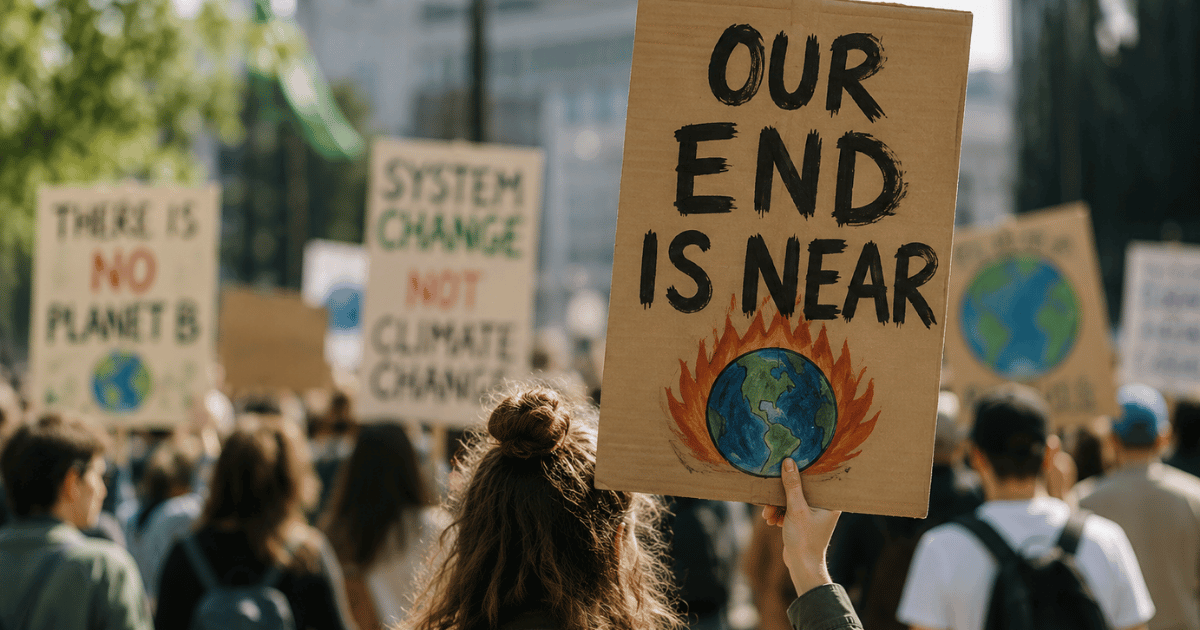
Why "Doomsday" Facts Alone Won't Change Behaviour
Let’s start with a familiar scenario.
You come across an article about climate change. The headline is alarming. The statistics are alarming. The projections are alarming.
By the time you’ve finished reading, you’re left with a sinking feeling in your stomach and the vague sense that humanity should probably get its act together.
You close the tab.
Maybe you share it with a friend. Maybe you spend a few minutes thinking about it. Then life happens.
There’s work to do, emails to answer, laundry to fold, WhatsApp messages you’ve been meaning to reply to for three days…
And before you know it, the moment has passed.
Sound familiar?
If so, you’re not alone.
For years, we’ve operated under the assumption that people don’t take action because they don’t have enough information. If only they understood the facts, the thinking goes, they would change their behaviour.
It sounds logical.
The problem is that human beings are rarely that straightforward.
We Know More Than Ever
The interesting thing about climate communication today is that awareness is no longer what it used to be.
Most people have heard about climate change. They’ve seen the headlines, watched documentaries, scrolled past alarming statistics, and perhaps even witnessed its effects in their own communities. Awareness, for the most part, isn’t the challenge it once was.
Yet awareness and action aren’t the same thing.
If they were, many of the problems we face today would look very different. Most of us already know we should exercise more, get enough sleep, and spend less time staring at screens. Knowing something is important doesn’t automatically make it easy to act on.
Human behaviour is messy. It’s influenced by emotions, habits, social norms, convenience, and a whole host of things that don’t always fit neatly into a graph. Climate action is no different.
That’s why simply presenting people with more facts, more graphs, or more alarming predictions doesn’t always produce the response we hope for.
When Everything Feels Urgent
Climate communication often relies on urgency.
And to be fair, there are good reasons for that. The issues we’re facing are serious, and many of them genuinely require immediate attention.
But when every communication sounds like an emergency, something unexpected can happen.
People become overwhelmed.
The problem starts to feel so large, so complex, and so far beyond their control that they struggle to imagine what meaningful action could even look like. Instead of feeling motivated, they feel powerless.
And this isn’t because people don’t care. In fact, it’s often the opposite.
Many people care deeply. They worry about the future. They want things to improve. They want solutions.
But caring about an issue and feeling capable of influencing it are two very different things.
When messages focus exclusively on catastrophe, audiences can be left with a strong understanding of the problem and very little understanding of where they fit into the solution.
Fear Can Grab Attention, But It Doesn't Always Create Action
Fear is incredibly effective at getting our attention.
That’s why dramatic headlines spread quickly. It’s why shocking statistics are shared widely. It’s why stories about worst-case scenarios often dominate conversations.
Fear tells us something is important.
What it doesn’t necessarily tell us is what to do next.
Imagine someone repeatedly telling you that a building is on fire. Initially, that information is useful. You need to know there’s a problem.
But after a while, you’ll probably have a different question.
Where’s the exit?
What can I do?
Who is helping?
How do we make things better?
Which is fair.
Climate and sustainability communications work in much the same way. People don’t just need a description of the problem. They need pathways towards action. They need examples, solutions and reasons to believe that their efforts can make a difference.
Without those things, even the most compelling evidence can leave people feeling stuck.
Stories Help Us Understand Our Place in the Bigger Picture
This is where storytelling becomes so valuable.
Facts and stories do different jobs.
Facts help us understand the scale of an issue. Stories help us understand our relationship to it.
A report might tell us that a region is experiencing increased water scarcity. A story can show us what that means for a farming family adapting to changing weather patterns.
A statistic might tell us that a community reduced waste by a certain percentage. A story can help us understand how that change happened, who was involved, and why it mattered.
Neither approach is more important than the other.
But together, they create something far more powerful.
Stories help people see themselves within a challenge. They make abstract issues feel tangible and remind us that change isn’t something that happens somewhere else, to someone else. It’s something people create every day through countless small decisions and actions.
And perhaps most importantly, stories help people imagine what’s possible.
Hope Isn't the Opposite of Urgency
Sometimes conversations about climate communication create a false choice.
Either we communicate urgency or we communicate hope.
Either we tell the truth about the challenges we face or we focus on solutions.
In reality, the most effective communication often does both.
Hope isn’t about pretending everything is fine.
It’s not about ignoring difficult realities or wrapping serious issues in a layer of positivity.
It’s about showing that action remains possible.
When people can see examples of progress, innovation, community action, or positive change, they’re more likely to believe that their own actions matter too.
That’s very different from being told, yet again, that everything is getting worse.
One message creates concern.
The other creates agency.
And agency is often what moves people from awareness to action.
Beyond the Headlines
The facts matter.
The science matters.
The evidence matters.
But facts alone rarely change behaviour.
People also need context. They need stories. They need examples that help them understand not only why an issue matters, but what can be done about it.
The goal of communication isn’t simply to make people aware of a problem. It’s to help them engage with it in a meaningful way.
Because while fear might capture someone’s attention for a moment, it’s rarely what keeps them engaged over the long term.
What keeps people engaged is the belief that change is possible.
That their actions matter.
That they’re not simply witnessing a problem unfold, but participating in a solution.
Because most people don’t need another reason to feel worried.
They need a reason to believe their efforts are worth it.
And perhaps that’s the real challenge for communicators.
Not helping people understand that a problem exists.
Most people already know that.
The challenge is helping them see where they fit into the story that comes next.